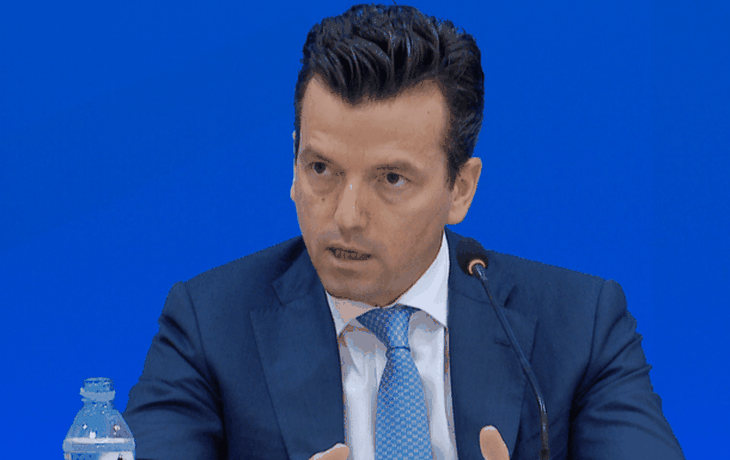


North Macedonia's Prime Minister, Christian Mickoski, during his meeting with European Commission President Ursula von der Leyen, today in Skopje, requested the European Union's mediation to resolve his country's disputes with Bulgaria, which have blocked Skopje's accession process.
"We openly discussed the challenges we face in relations with our eastern neighbor (Bulgaria). Our wish is that these issues are overcome through dialogue, with goodwill and mutual respect. I emphasized that we expect the EU to participate in this process. We are not asking the Union to take sides, we are asking it to help create the conditions for a sustainable European solution," Mickoski said, at a press conference after meeting with von der Leyen.
According to foreign media reports, the president of the European Commission said that North Macedonia's European path could continue after the country amends its Constitution to include the Bulgarian minority living in the country. Von der Leyen stressed that lifting the block on the constitutional amendment would allow North Macedonia to accelerate its path towards the EU.
"Once this deadlock is resolved, North Macedonia's accession process can proceed rapidly, as the necessary reforms are already being intensively implemented," Ursula von der Leyen noted.
However, Sofia does not seem willing to renegotiate with Skopje the obligation to constitutionally recognize the Bulgarian minority in North Macedonia. Bulgarian Prime Minister Rumen Radev has stated that North Macedonia must respect the rights of the Bulgarian minority and include it in its Constitution, emphasizing that the accession process for Skopje is a matter of fulfilling the criteria set by the European Union itself.
The problematic relations between North Macedonia and Bulgaria
North Macedonia's European path remains blocked, as Skopje has failed to fulfill the obligations it undertook based on a proposal presented by the EU in the summer of 2022. The proposal envisages amending the Constitution of North Macedonia to include the Bulgarian minority living in the country. The proposal was accepted by the previous center-left government, but without securing the required two-thirds majority in Parliament.
The amendment was opposed by Hristjan Mickoski's right-wing VMRO-DPMNE, which was in opposition at the time and took over the government in June 2024. Hr. Mickoski continues to reject amending his country's Constitution in the current circumstances, while Brussels and Sofia reiterate that its implementation is a necessary step to open the chapters of the accession negotiations.
According to the latest census conducted in 2021 in North Macedonia, Bulgarians make up only 0.2% of the country's population (a total of 3,500 people), a fact that official Sofia disputes and believes that the percentage of Bulgarians in North Macedonia is much higher. Sofia believes that the census was conducted using methods that did not ensure the participation of all Bulgarian citizens in the country and accuses Skopje of silencing the historical Bulgarian presence.
The clash with North Macedonia's Bulgarian minority further strains relations between the two neighboring countries, which have been marked for decades by disputes over history, national identity and language. Tensions have escalated since VMRO-DPMNE returned to power in June 2024.
Ursula von der Leyen's tour
Skopje was the last stop on the European Union President's tour of the Western Balkans, which began on September 30 and ended today. It was preceded by visits to Tirana, Pristina and Podgorica, where von der Leyen discussed their European perspectives with the leaders of Albania, Kosovo and Montenegro.
Belgrade and Sarajevo were not included in the program due to the upcoming elections in Serbia and Bosnia and Herzegovina. The President of the European Commission intends to visit both countries at a later date.